Strategic planning, educational design, assessing health care needs, facilitation, and amplifying access to information by bringing together the best people and brightest ideas.
From Guardrails to Possibilities
Most CPD conversations about AI begin with guardrails: disclosure, compliance, validation, policy, risk. Those conversations matter. But they also focus the conversation on what’s allowable. We want to explore what’s possible.
AI doesn’t matter because it’s faster or smarter. It matters because it changes the space we’re working in. And when the space changes, so do our responsibilities.
Think of exploration. Traditionally, we plan carefully—maps, tools, rations, backup plans. In CPD, that looks like robust workflows designed to survive complex, regulated systems. Necessary. Sensible. Safe.
AI invites a different kind of journey.
It allows us to prototype before we fully understand the question. To see patterns before we’ve named the problem. To test assumptions we’ve learned to live with rather than challenge.
The real work isn’t learning what AI can do….It’s deciding what questions we’re finally willing to ask.
Our session at the 2026 Alliance for Continuing Education in the Health Professions invites CPD leaders to step back—and then forward—by examining the constraints we treat as fixed, the workarounds we’ve normalized, and the possibilities that emerge when we see learner and system reality sooner.
This is not a tools demo or a how-to session.
It’s a pause. A reframing. A moment of courage.
Because guardrails matter—but possibility is where leadership lives.
MDD Minds: Addressing Global Disparities in Mental Health
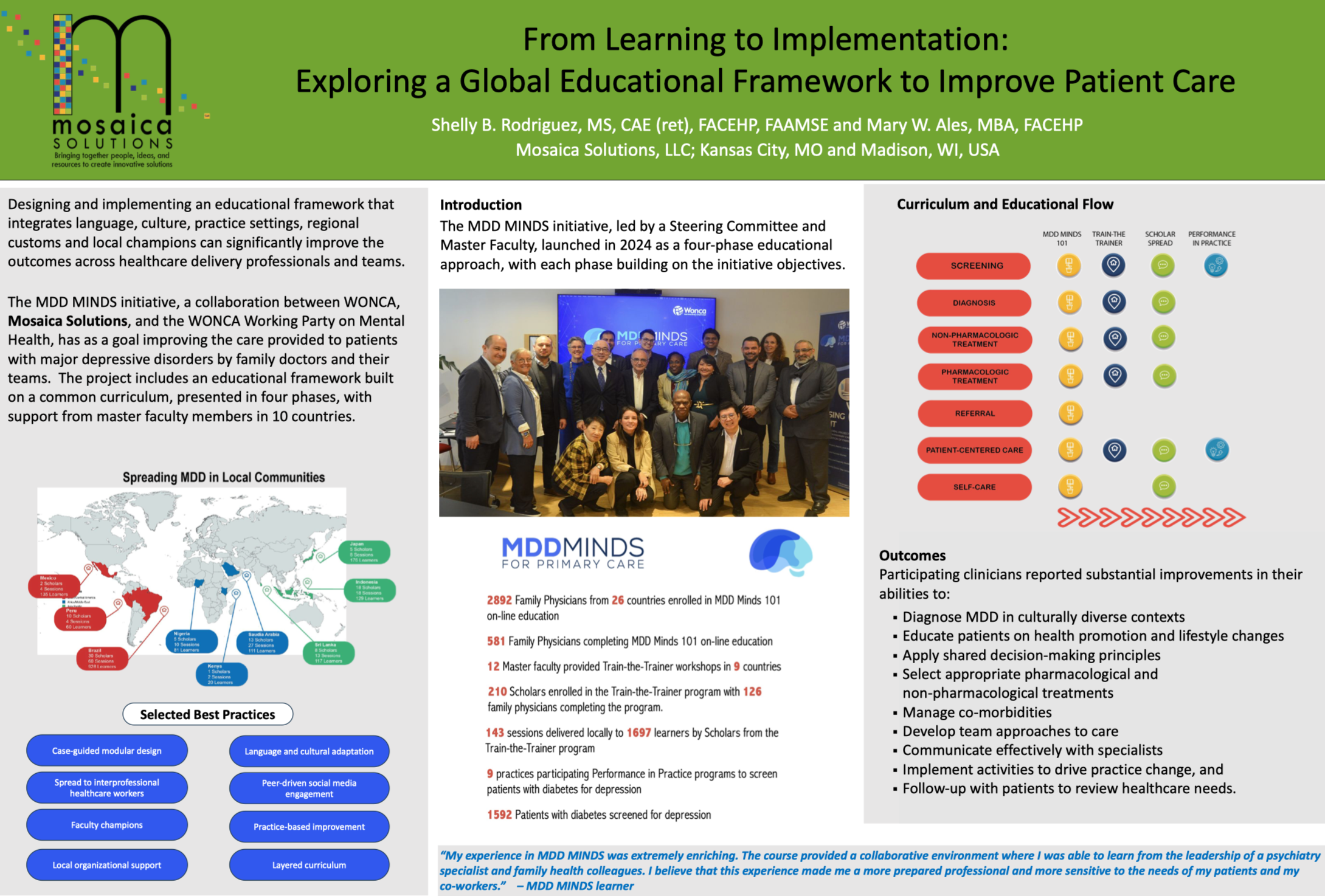
The MDD MINDS FOR PRIMARY CARE Program aims to enhance the quality of care for major depressive disorders delivered by family doctors in Africa-Middle East, Asia, and Latin America.
This initiative includes three phases: a self‑paced online course - "MDD Minds 101", a more in‑depth Train‑the‑Trainer course, and a performance in practice initiative.
Mosaia Solutions was thrilled to be part of this global initiative as we supported the overall management, curriculum development, faculty training, and outcomes assessment. Read more about our work here and look out for our upcoming publication on our global performance in practice work.
Organizational Strategic Planning
As organizations regroup after the pandemic, they find that their members, community stakeholders, funding model and mission need a little brushing off. How does their WHY - their purpose in the community - accommodate today’s reality? What does their organizational future hold?
These past months have connected us to several organizations asking these questions. Through conversations within and around these organizations, we have designed custom programs that engage organizations in highlighting their successes. By exploring your dreams, you fortify your plans to that you are poised for success.
Knowledge Translation:
Supporting Learning and Change
Understanding how physicians determine when they need more information, their trusted sources and how they integrate new information into practice to improve patient care was the beginning of this three-year project. The capacity and competence of CME/CE/CPD and quality improvement professionals to meet the knowledge translation needs of their learners was explored. Working with 11 education providers from medical societies to academic medical centers, health systems to ACOs, Mosaica Solutions guided a learning collaborative through educational planning, use of data, integration of feedback, and support for change processes.
- Over 1000 vaccinations given.
- More than 1600 conversations shared the benefits of influenza immunization for promoting health.
- Over 1300 patients received information on the health benefits of the influenza vaccine.
Congratulations to the 21 members of the Georgia Academy of Family Physician who completed the Enhancing Physician-Patient Conversations
Addressing Vaccine Hesitancy project. Over 1000 influenza vaccines were delivered to adults 50 years and over who had not had a flu shot in the past 2 years. These family physicians shared their best practices with each other as they worked with their teams to create a vaccination culture in their clinics. And they met their ABFM Maintenance of Certification Performance in Practice requirements. Well done!
“I had a 63-year-old patient who has never taken a flu shot, his only reason being “I have never been told why I needed to have one, but only been told to take it. It took only a small conversation to explain why and my patient agreed.” GA family physician
The Illinois Academy of Family Physicians invested in their board leadership during their November meeting. From lions to monkeys and turtles to camels, they explored how their communication styles impact their work as leaders in family medicine.
Addressing Gaps in Lung Cancer Care
Mosaica Solutions led a project to improve healthcare equity for lung cancer patients in China, with a focus on non-small cell lung cancer (NSCLC), which makes up 85% of lung cancers globally. Our team facilitated a roundtable discussion with lung cancer specialists, pathologists, and healthcare experts from China and abroad. The discussions identified significant gaps in care, particularly between urban and rural healthcare services, and highlighted barriers such as limited access to advanced testing and treatment options.
Key strategies were proposed to address these disparities, including strengthening rural healthcare capacity, enhancing physician education, and improving access to targeted therapies. The project emphasized the need for policy changes to ensure equitable care across all regions and healthcare settings. These efforts align with China’s Healthy China 2030 initiative, which aims to increase the five-year survival rate for lung cancer by 15%.
Building Community Capacity
The national public health emergency for the COVID-19 pandemic expired in May 2023. As we transition to living with COVID-19, we can’t forget the responses needed by our communities, our clinics and health care staff working together to keep us healthy. Our Building Community Capacity project provides clinics and community organizations in underserved areas the opportunity to reflect and consider what we have learned then record our lessons so that we are all better equipped for the next pandemic. Reflections have been shared the California Department of Public Health, and the California Academy of Family Physicians.
Through this work we identified six recommendations for clinics and residency programs as they undertake capacity building for community crisis management -
Develop Incident Command and Emergency Response Teams.
Build communications plans to keep staff, patients and the community informed.
Engage community stakeholders in strategic relationships.
Provide education to staff, patients and community members so that everyone has the needed knowledge.
Implement mobile technology to meet patients where they are in the community.
Promote relationships with public health and community organizations that support sharing of resources and infrastructure.
We are grateful for the opportunity to learn and share with these dedicated organizations.
The Changing Landscape of Obesity
We present a detailed examination of the current state and future directions in obesity management. Through discussions with healthcare professionals, patients, and industry stakeholders, we identify seven key themes: societal perceptions, recognizing obesity as a chronic disease, improving care delivery, financing treatment, shaping policy, understanding economic impacts, and prioritizing patient-centered approaches.
Our analysis highlights the necessity of treating obesity with a comprehensive, multimodal strategy that includes support from a broad spectrum of healthcare providers. We explore the challenges and opportunities in financing obesity treatment, the importance of equitable care, and the role of technology and telehealth in expanding access to care.
Key questions are raised about how individuals with obesity will navigate new treatment options, the societal stigma of obesity, and the alignment of policies and coverage to support comprehensive care. We suggest the potential for significant advancements in obesity management through collaborative efforts that link employers, healthcare providers, and policymakers to support evidence-based, affordable, and accessible care.
This overview offers insights into the complexities of obesity care and underscores the importance of a collaborative, patient-focused approach to address this chronic disease effectively.
This work was funded through an Independent Educational Grant from Pfizer
Grant Writing Workshops
Mosaica’s grant writing workshops are collaborative learning opportunities designed for researchers, clinicians, and others engaged in grant writing, project proposals and education. These workshops are an interactive virtual experience … a hands-on opportunity for participants to build writing and proposal skills, design outcomes strategies, use tools and resources, engage with master faculty and research experts, and learn from each other. Enrollment has been extended through 2024 for our second grant writing workshop in China.
Mental Health in Latin America
Working with an international expert advisory panel of clinicians, Mosaica’s needs assessment and environmental scan on the mental health care provided by family medicine and primary care physicians in five Latin American countries (Argentina, Brazil, Chile, Columbia and Mexico) will characterize and provide up-to-date local/regional epidemiological data on mental health conditions; broaden understanding differences and commonalities in how mental health care is delivered and managed; and explore the general disease burden in Latin America, including barriers to providing care and recommendations for potential solutions to address the barriers and close identified gaps.
Open Access Publishing:
Evolution, Transformation and Adaptation
We find ourselves in an environment where technological advancements have streamlined the availability of online access to research and publications and funders of research are now demanding faster dissemination of scholarly research to a global audience. Society is also unwilling to compromise on integrity and ownership of content is moving toward commons where data can be freely shared with proper attribution. This environment is the birthplace of the Open Access (OA) movement … a movement fueled by content ownership, transparency and distribution. The goal of OA is to equalize publication and access while maintaining the expected research standards.
Mosaica Solutions hosted a multi-stakeholder roundtable to explore the transformation of traditional publishing to the world of OA by examining: the successes of OA in achieving its mission; the challenges preventing OA from continuing its success; the opportunities that remain to be developed; and the disrupters that will influence adoption of OA. Our goal is to explore those factors that will further the transformation of open access publishing and drive OA adoption across the global medical community.
Exploring Real World Evidence in Asia Pacific
The use of Real World Data (RWD) leading to Real World Evidence (RWE) has highlighted the role of data to improve a population’s health. Look no further than the implementation of vaccines to treat the COVID-19 pandemic. RWE supports randomized control trials by highlighting the use of therapy within a population thereby allowing researchers and policy makers alike an understanding of the clinical effectiveness in a population. To better understand the implications of RWE in the Asia Pacific region, Mosaica Solutions is developing a needs assessment within Hong Kong, India, Indonesia, Malaysia, Philippines, Singapore, Taiwan, Thailand, and Vietnam. Results from this study will be shared to stakeholders in opportunities to improve the health of a country’s residents and the cost to the economy.
New Teaching Curriculum
Fifty faculty from around the globe — including Shelly — contributed to a new teaching resource titled Family Medicine in the Undergraduate Curriculum. Together we can encourage a new generation of healthcare workers to care for our growing population. Thanks to all the authors for their commitment.